Joker Poker Guide: Rules, Hands and Paytables
Karkiya's listed categories include Crash, Aviator, sports events, WM Live, Teen Patti, and slots, but the evidence does not establish Joker Poker availability. This page therefore does not launch a Karkiya game; it is a general learning guide. Most versions deal five cards, let the player hold selected cards, and replace the rest once. The joker usually acts as a wild card to complete a hand, but rules and paytables vary by version.
Each hand is resolved randomly; earlier hands do not alter the next result.
Review which cards to keep before confirming the draw.
Set time and loss limits before starting.

- Read the joker rule first
- Check the lowest paying hand
- Review holds before drawing
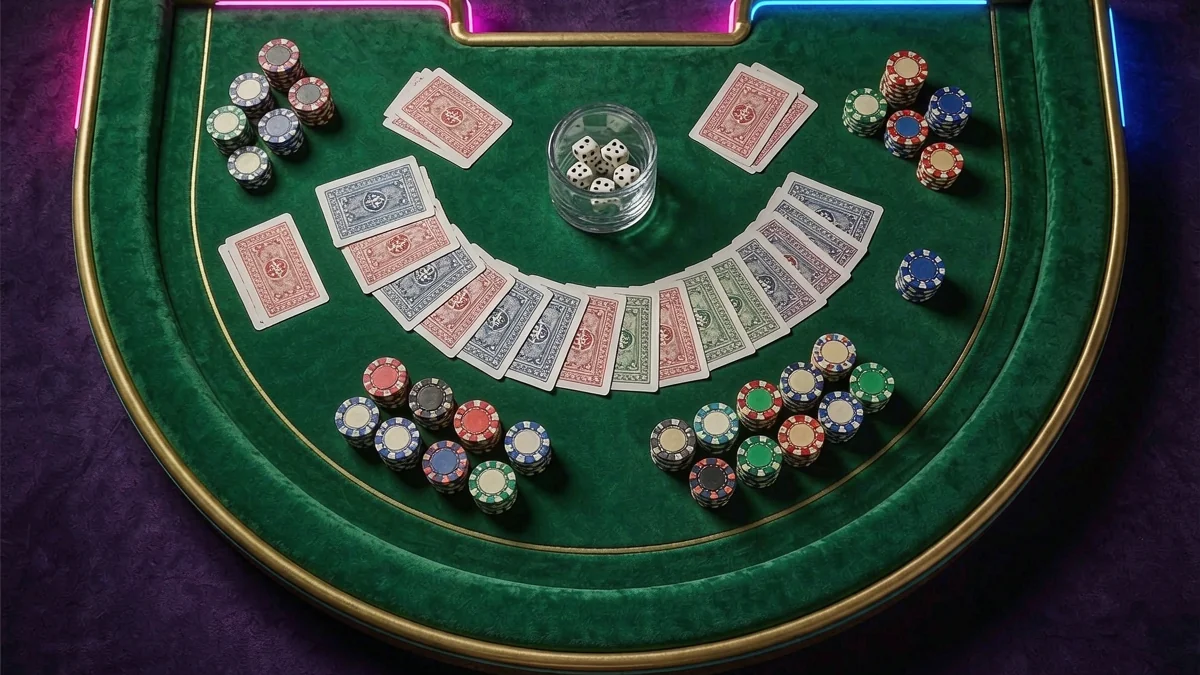
A general illustration of a five-card Joker Poker hand, the joker's role, and winning combinations; it is not a verified Karkiya interface screenshot.
How Joker Poker Differs From Standard Draw Poker
Like standard draw poker, Joker Poker builds a final hand from five cards. The defining difference is the joker. In one version it may substitute for any card, while another may restrict how it completes a hand. Read the joker's exact role before play because the same hold can have a different value under different rules.
Hand rankings commonly progress through pair, two pair, three of a kind, straight, flush, full house, four of a kind, straight flush, and royal flush. The lowest paying hand is not universal, however. Some versions require kings or better, while others use another threshold. Familiar poker rankings do not replace reading the displayed paytable.
A wild joker can make strong hands easier to form, but the paytable may compensate by reducing rewards for some combinations. Do not judge a game by one headline prize. Compare every hand value, any distinction between natural and joker-assisted hands, and the cost per round. No specific paytable or return is claimed here for Karkiya.
Checks Before You Start
- Read whether the joker is fully wild or restricted
- Find the lowest paying hand on the displayed paytable
- Confirm how many cards may be replaced each round
- Set the cost per hand and total budget in advance
- Do not raise stakes to recover losses
Understanding Joker Poker RNG and Independent Outcomes for Karkiya Readers
In a computer-based card game, outcomes are commonly produced from the output of a random number generator, or RNG. This video provides general technical background on true random numbers, pseudo-random numbers, and seeds. It does not test a Karkiya game or establish that Joker Poker is available there.
A properly implemented RNG does not treat a player's previous wins, losses, or hold choices as a promise about the next result. Several weak hands do not make a strong hand due, and a run of favourable outcomes does not improve the probability of the following hand.
An RNG may generate random outcomes, but the paytable assigns financial value to them. Randomness, return, and variance are therefore distinct: the RNG selects cards, the paytable defines rewards, and variance describes how sharply results may fluctuate over shorter periods. Assessing a specific version requires both its rules and complete paytable.
This video offers general education on how random number generators work. It is not evidence of a specific Joker Poker implementation, paytable, expected return, licence, or the game's availability at Karkiya.
the roadmap · English · Watch on YouTube
- Previous hands do not guarantee the next result
- The RNG and paytable perform different jobs
- Short-term results fluctuate because of variance
- Use demo mode first if available
- Confirm the cost per round
- Set time and loss limits
A general illustration of checking rules, the paytable, and session limits; it does not show a working Karkiya game or account page.
Four Practical Steps Before Playing Joker Poker
Step 1: Identify the game variant
First, note that Joker Poker availability at Karkiya is not established. If you encounter such a game, identify the variant by reading its rules and paytable; the poker guide provides additional background on hand rankings.
Step 2: Check the joker's role
Read the rules to determine which cards the joker can replace and whether hands containing a joker receive separate rewards. The poker guide explains the standard hands you can use as a reference.
Step 3: Read the paytable
Before playing, check the reward for each hand, the minimum qualifying hand, and how payouts change across stake levels. See the poker guide for a general explanation of hand rankings and table decisions.
Step 4: Practise hold and draw decisions
Choose which cards to keep from the initial five; discarded cards are replaced, and the final hand is evaluated against the paytable.
These steps help beginners understand the rules. No holding method guarantees a win, because every draw is uncertain and outcomes may be independent.

- Do not break made hands casually
- Prefer one coherent draw
- Record each decision
A general illustration of card-hold and draw decisions; it does not confirm strategy for any specific Joker Poker version.
A Sound Basis for Joker Poker Decisions
Start with your current hand and its possible improvements. Whether to keep a made pair or pursue a straight depends on the specific paytable and joker rules. Previous rounds do not provide a reliable signal about the next draw.
Games carrying the Joker Poker name can use different paytables. Instead of relying on a generic strategy, compare the current version's rewards for a natural royal flush, joker royal, five of a kind, and its lowest qualifying hand.
When comparing probabilities, consider both the payout for each possible final hand and the chance of making it. Focusing only on the largest reward can hide the risk created by its low probability. The poker guide provides related guidance on hand rankings and decision-making.
Common Joker Poker Mistakes
A common mistake is applying a familiar video-poker strategy without reading the rules. A wild joker changes hand probabilities, while the minimum qualifying hand and payouts can vary by version. Another mistake is failing to set time and spending limits before play.
Raising the stake after a losing round in an attempt to recover losses increases risk. It is also a mistake to assume that a card is "due" based on recent outcomes. For supporting information, review the FAQ, Privacy Policy, and Terms and Conditions.
Another mistake is ignoring breaks and loss limits. The responsible gaming guide explains how to set firm time and spending limits in advance.

- Treat each hand independently
- Avoid chasing losses
- Reconcile records after the session
A general illustration comparing card outcomes with long-term records; it is not live data or a Karkiya match listing.
Knowing Hand Names vs Reading the Paytable
| Area | Surface-level approach | Informed approach |
|---|---|---|
| Selecting holds | Chasing only the top reward | Comparing probability and payout together |
| Previous outcomes | Treating them as a signal for the next hand | Treating outcomes as independent |
| Spending control | Changing limits during play | Setting firm limits in advance |
| Learning method | Using one strategy for every version | Checking each version's rules and paytable |
| Record keeping | Remembering wins only | Recording total stakes, returns, and time |
Paytable-based thinking means considering each decision's possible outcomes and rewards together. Even correct strategy cannot guarantee the result of a single round or remove the game's built-in advantage.
Joker Poker is a useful video-poker example for readers interested in rules and probability. Practising with a paytable without using real money is a lower-risk way to learn.
How to Stay in Control with Joker Poker
Keep the purpose limited to entertainment and learning the rules. Before starting, write down the session length, maximum spend, and stopping point. Do not treat any single win or loss as a prediction of what comes next; rounds are uncertain.
Set time and spending limits before playing, take regular breaks, and stop when you reach a preset limit. The responsible gaming guide explains these controls and when to seek support. For another cautious game overview, see The Great Icescape guide.
Stop immediately if decisions become emotional, a preset limit is reached, or you feel an urge to recover losses. Taking a break is a practical way to retain control.
Joker Poker Checklist
Conclusion: Rules, Paytables, and Limits Matter
A wild card increases the range of possible hands in Joker Poker, but the exact rules vary by version. Do not rely on the title alone; read how the joker works, which hands qualify, and the payout at each stake level.
Strategy may reduce expected losses, but it cannot guarantee a profit or a win. Treat the budget as an entertainment expense, never use borrowed money, and keep a complete record of results.
There is no evidence that Joker Poker is listed at Karkiya. If you encounter the game on an external site, independently check its current rules, paytable, cost, and responsible-use controls before taking part.